


Reception Cultural Capital Curriculum 2026-27
Curriculum Rationale
At Poulner Infant School and Nursery, our curriculum starts first and foremost with the child. We believe that cultural capital—the wealth of experiences, knowledge, and skills that help children navigate and appreciate the world—is a shared journey. It begins with the unique experiences children bring from their family homes, friends, and communities, and is deeply enriched by their time in our school.
From the moment children start in Reception, our priority is to establish a nurturing bond, getting to know them as individuals within a safe and secure team environment. Once settled, we co-create a bespoke, responsive curriculum that celebrates their strengths, addresses their needs, and actively embeds our school values of Creativity, Collaboration, and Challenge.
To facilitate deep learning, we offer children extended periods of uninterrupted play within a rich continuous provision. This time empowers them to innovate, collaborate, and safely challenge themselves and each other. We personalise learning by weaving in the children’s current interests, developmental schemas, and individual needs. Thoughtfully designed invitations to play and environmental provocations are used to spark curiosity, ignite imagination, and foster a lifelong love of learning.
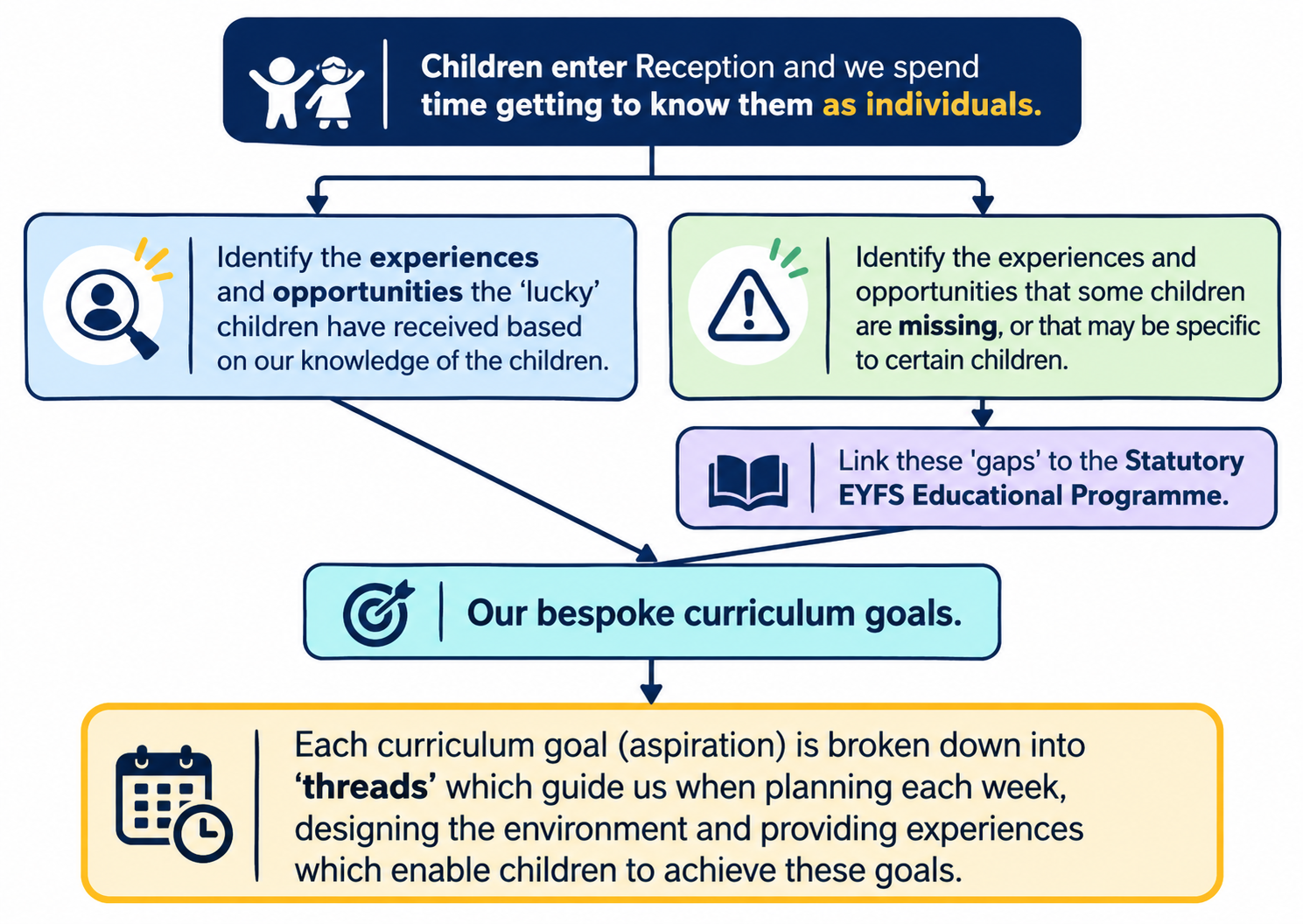
Our practice is underpinned by a continuous cycle of reflection. By constantly assessing the children’s play, the layout of our learning environments, and our own pedagogy, we ensure our provision remains dynamic, purposeful, and entirely focused on the child.
Cultural Capital - What do some of our children experience at home?
- Trips out to the beach
- Walks in the forest
- swimming / football/ dancing/ gymnastics/ forest school sessions
- Fine motor activities like colouring, cutting, being creative
- Holidays- boats, trains, planes, camping
- Reading books together
- Messy / sensory play
- Playing in a garden / parks
- Cooking and eating meals together
- Talking and conversation
- Free active time in which they organise themselves in their play
- Play which supports development of core strength and upper-body pivots
- Access to small world play and construction
What do we know about our children? & Links Stat. EYFS Educational Programme
- Some are not exposed to a range of vocabulary. C&L: The number and quality of the conversations they have with adults and peers throughout the day in a language-rich environment is crucial. By commenting on what children are interested in or doing, and echoing back what they say with new vocabulary added, practitioners will build children's language effectively.
- Some do not experience a wide range of stories and are given the opportunity to develop them further. C&L: Through conversation, storytelling and role play, where children share their ideas with support and modelling from their teacher, and sensitive questioning that invites them to elaborate, children become comfortable using a rich range of vocabulary and language structures.
- Some do not experience sitting and talking at meal / snack times. C&L: through conversation, with support and modelling from their teacher, and sensitive questioning that invites them to elaborate, children become comfortable using a rich range of vocabulary and language structures.
- Some lack confidence in themselves and their capabilities. PSED: Children should be supported to manage emotions, develop a positive sense of self, set themselves simple goals, have confidence in their own abilities, to persist and wait for what they want and direct attention as necessary
- Some struggle to make friends and play co-operatively. PSED: Through supported interaction with other children, they learn how to make good friendships, co-operate and resolve conflicts peaceably. These attributes will provide a secure platform from which children can achieve at school and in later life.
- Some have not experienced social play involving sharing / taking turns. PSED: Through supported interaction with other children, they learn how to make good friendships, co-operate and resolve conflicts peaceably.
- Some struggle to share adult attention, wanting 1:1 time. PSED: Children should be supported to persist and wait for what they want, and direct attention as necessary.
- Some children are demonstrating behaviours associated with spectrum conditions eg, ASD / ADHD. PSED: children’s PSED is crucial for children to lead healthy and happy lives and is fundamental to their cognitive development.
- Some have not experienced boundaries / consistency in boundaries. PSED: Through supported interaction with others, they learn to co-operate.
- Some seek gross motor and heavy work activities. PD: By creating games and providing opportunities for play both indoors and outdoors, adults can support children to develop their core strength, stability, balance, spatial awareness, co-ordination and agility. Gross motor skills provide the foundation for developing healthy bodies and social and emotional well-being.
- Some do not have scissors or other creative tools at home PD: practice of using small tools, with feedback and support from adults, allow children to develop proficiency, control and confidence.
- Some experience high levels of screen time and lack the communication skills, physical strength and imagination to play. PD: Physical activity is vital in children’s all-round development, enabling them to pursue happy, healthy and active lives.
- Some struggle to recognise phonemes and graphemes taught in school L: Skilled word reading, taught later, involves both the speedy working out of the pronunciation of unfamiliar printed words (decoding) and the speedy recognition of familiar printed words.
- Some lack knowledge and understanding with numbers beyond 3. M: By providing frequent and varied opportunities to build and apply this understanding - such as using manipulatives, including small pebbles and tens frames for organising counting - children will develop a secure base of knowledge and vocabulary from which mastery of mathematics is built.
- Some struggle to have 1 to 1 correspondence when counting (particularly things that cannot be moved) Children should be able to count confidently, develop a deep understanding of the numbers to 10, the relationships between them and the patterns within those numbers.
- Some lack the sensory experiences within nature UTW: Understanding the world involves guiding children to make sense of their physical world and their community. The frequency and range of children’s personal experiences increases their knowledge and sense of the world around them.
- We live in an area with low levels of diversity. UtW: listening to a broad selection of stories, non-fiction, rhymes and poems will foster their understanding of our culturally, socially, technologically and ecologically diverse world.
- Some are not given the opportunity to be creative at home. EAD: The frequency, repetition and depth of their experiences are fundamental to their progress in interpreting and appreciating what they hear, respond to and observe.
Our Curriculum Goals
What Key things do our children need to experience by the time they leave Reception?
- C&L: To extend vocabulary when communicating in full sentences, using descriptive words and simple conjunctions (eg, 'and', 'because', 'so') to link thoughts.
- PSED: To collaborate in shared play; valuing the input of peers and demonstrating kindness and respect.
- PSED: To develop emotional resilience through recognising and regulating feelings; respecting the boundaries and routines of the class and school community.
- PD: To support children’s physical stamina and wellbeing, including participation in a range of active experiences designed to calm the nervous system.
- Literacy: To inspire a love of literacy by immersing children in a rich world of stories, rhymes and poetry which fuel their early mark-making and writing.
- Literacy: To write recognisable letters that match taught sounds; segmenting simple words to write them independently.
- Mathematics: to develop number sense to 10 through hands-on exploration and mathematical talk, enabling children to confidently subitise, count and solve simple problems.
- UTW: To foster curiosity through regular outdoor experiences, empowering children to observe seasonal changes, interact with nature, and ask questions about the living world.
- UTW: To explore and respect different cultures, families, and traditions; proudly sharing their own unique identity and celebrating those of their peers.
- EAD: To develop creative confidence through exploration and manipulation of materials and sensory media; safely using tools and joining techniques to express ideas.
- EAD: To think creatively during discovery time, using their imagination to independently select and use resources with clear intent, purpose, and focus.