


Little Acorns Cultural Capital Curriculum 2026-27
Curriculum Rationale
The Poulner Infant School Nursery curriculum starts first and foremost with the child. As children enter Little Acorns, we get to know them, treating them as individuals and creating a nurturing bond with a Key Worker. Once settled in September (our main entry point), we create our curriculum, using the Hampshire Cultural Capital Curriculum Toolkit.
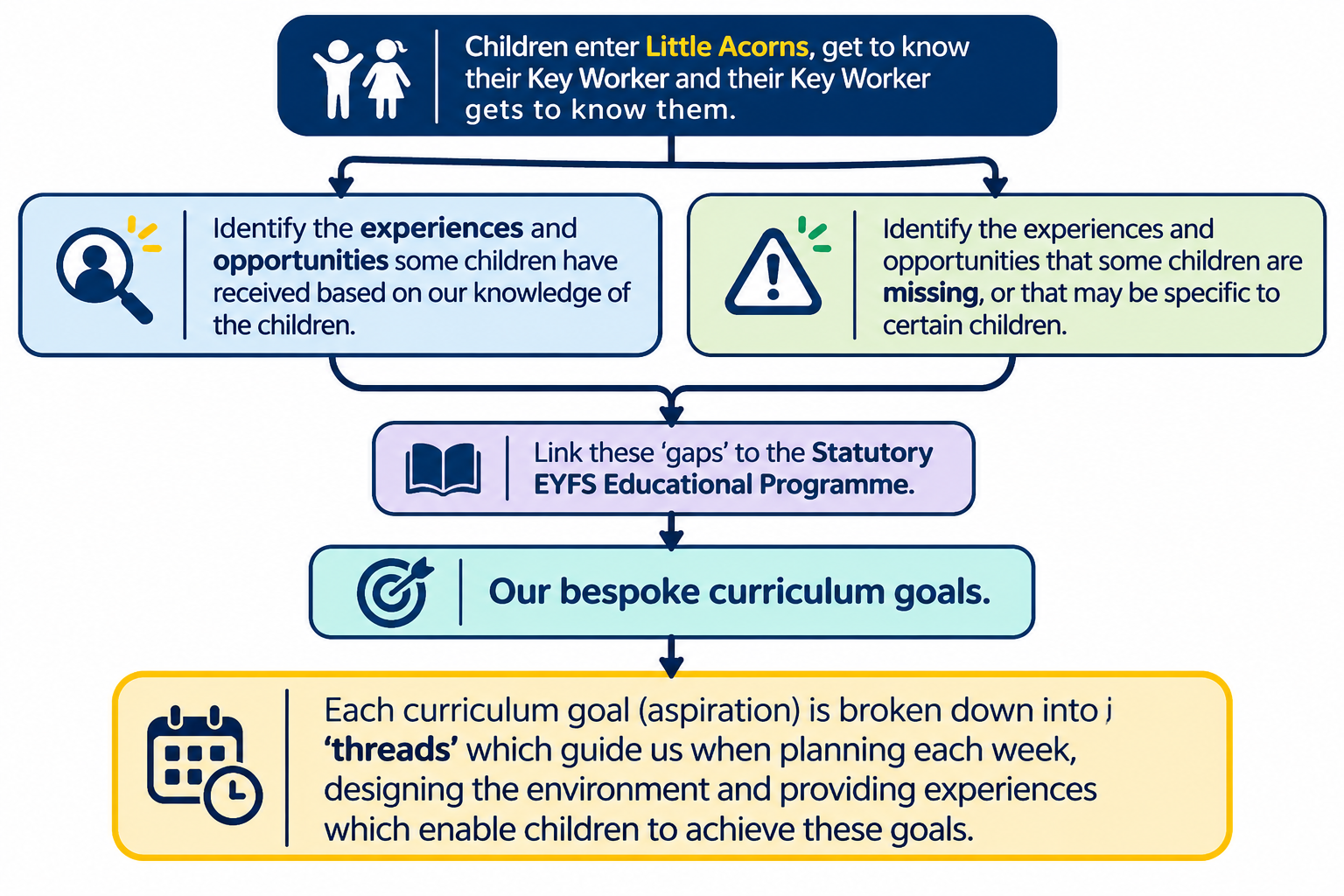
In Little Acorns, we develop a curriculum which meets the needs of all children, taking into account their age and stage. We aim to develop a range of skills, prioritising the prime areas and the areas of development identified as their next steps. We have a balance of adult-led and child initiated play throughout the day, ensuring this meets the needs of that cohort. We plan small group circle times which have specific learning objectives linked to identified needs and ‘next steps’ of each group of children according to their stage of development.
Alongside, we offer children long periods of uninterrupted free play in order to access continuous provision during which time focus children are identified and ‘In the Moment Planning’ enables us to further personalise the children’s learning through the use of their interests, schema and needs. Invitations to play and enhancements are designed to spark interest, curiosity and a love of learning. Within this, our school values of Collaboration, Creativity and Challenge are embedded throughout the environment and ethos.
Assessment of the children through their play, the environment we offer and ourselves as practitioners allows a continuous, reflective practice. Each term, we assess each Key child to identify next steps. Parent questionnaires which are sent out before a child’s focus week are also an important source of information.
We recognise that the children in our care exist in a very fast-paced world. We aim to provide them with unhurried experiences; the time to fully appreciate and explore their environment at their own pace through a deliberate commitment to slow pedagogy. In an era where working parents and families face intense demands, we understand that active parental engagement at home can sometimes be unintentionally reduced by the constraints of unavoidable pressures. By offering a calm, unpressured sanctuary we bridge this gap, ensuring every child receives the deep, focused attention and unhurried time they need to thrive, discover, and simply be.
2026-27 Cultural Capital Curriculum
Cultural Capital- what do some of our children experience at home?
- Trips out to the beach
- Walks in the forest
- Holidays- boats, trains, planes
- Reading books together
- Playing in a garden / parks
- Eating meals together at a table
- Talking and conversation
- Time spent out of restraints (car seat, pushchair, highchair, bumbo seats etc)
- Experience of ‘unscheduled’ time to play and be bored.
- An abundance of toys
- Taking on a role in their play
What do we know about our children? & Links to Statutory EYFS Educational Programme
- Some do not experience sitting and talking at meal / snack times. C&L: through conversation, with support and modelling from their teacher, and sensitive questioning that invites them to elaborate, children become comfortable using a rich range of vocabulary and language structures.
- Some children are not consistently read bedtime stories. C&L: Reading frequently to children, and engaging them actively in stories, non-fiction, rhymes and poems will give them the opportunity to thrive.
- Some have not experienced boundaries / consistency in boundaries. PSED: Through supported interaction with others, they learn to co-operate.
- Some experience high levels of screen time and lack the communication skills, physical strength and imagination to play. PD: Physical activity is vital in children’s all-round development, enabling them to pursue happy, healthy and active lives.
- Some have not experienced social play involving sharing / taking turns. PSED: Through supported interaction with other children, they learn how to make good friendships, co-operate and resolve conflicts peaceably.
- Some children still have dummies / had recently and have unclear speech. C&L: By commenting on what children are interested in or doing, and echoing back what they say, practitioners build children’s language effectively.
- Some children have not experienced sensory play / imaginative craft EAD: It is important that children have regular opportunities to engage with the arts, enabling them to explore and play with a wide range of media and materials.
- Some children have not had sufficient levels of ‘tummy time’ as a baby / toddler PD:
- Some children have not attended toddler / library groups Literacy: Language only develops when adults talk with children about the world around them and the books they read with them, and enjoy rhymes, poems and songs together.
- Some children have parents who have not collaborated with external support services eg, health visitors Assessment: assessment plays an important part in helping parents, carers and practitioners to recognise children's progress, understand their needs and to plan activities and support.
- Some children have had no experience of being looked after by anyone other than their parents UtW: The frequency and range of children’s personal experiences increases their knowledge and sense of the world around them.
- Some children have not been exposed to mathematical language and experiences: MD: It is important that children develop positive attitudes and interests in mathematics.
- We live in an area with low levels of diversity. UtW: listening to a broad selection of stories, non-fiction, rhymes and poems will foster their understanding of our culturally, socially, technologically and ecologically diverse world.
Our Curriculum Goals
What Key things do our children need to experience by the time they leave Little Acorns?
- PSED: Children will have formed a positive and trusting relationship with their key worker and develop skills required to progress from co-regulation to more independent regulation of emotions.
- PSED: Children will have experienced a range of turn taking activities, and begin to understand the importance of sharing with their peers.
- C&L: Children will have developed a vocabulary consisting of a progressive range of nouns and verbs.
- C&L: Children will have opportunities to develop back and forth conversations with both adults and peers, extending to imaginative role-play.
- C&L: Children will have opportunities to listen to, process and follow one step instructions.
- PD: Children will experience and risk assess a range of physical activities which support ‘whole body’ development, including tummy time.
- Literacy: Children will be exposed to a range of traditional tales and nursery rhymes.
- Mathematics: Children will start to see and talk about maths in daily life including colours, shapes and collections.
- EAD: Children will explore diverse craft and sensory materials at their own pace, sparking natural curiosity and creative imagination.
- UtW: Children will notice similarities and differences between themselves and others, providing opportunities to celebrate diversity.
- UtW: Children will experience, respect and be curious about the natural world around them.
|
Aspiration 1: PSED: Children will have formed a positive and trusting relationship with their key worker and develop skills required to progress from co-regulation to more independent regulation of emotions. |
||
|
Curriculum Goal |
Core experiences |
Resources |
|
Thread 1 (2-3 years) Be increasingly able to talk about and manage their emotions |
Adults explicitly label the child's emotions as they happen ("Your hands are clenched, you look frustrated"). Physical comfort offering, and down-regulating tone adjustment during moments of dysregulation. |
Present and engaged adults. Visual emotion lanyards worn by key workers. Areas with soft textures, weighted plush toys, and calming tactile objects. Visual emotion/feeling cards. |
|
Thread 2 (2-3 years) Develop friendships with other children, safely exploring emotions beyond their normal range through play |
Focus on feelings weekly in Autumn term. Guided pair interactions with shared toys to practice turn-taking. Sharing of books where children are exposed to a range of emotions. Adult-led roleplay scenarios using puppets to test out emotions. |
Low-level safety mirrors paired with emotion-expression photo cards. Puppets or persona dolls representing different feelings. Curated book spine |
|
Thread 3 (3-4 years) Help to find solutions to conflicts and rivalries |
Structured conversations utilising restorative questions ("What happened?", "How can we make it better?") |
Present and engaged adults. Timer sandglasses to manage self-directed turn-taking. Scripted story scenarios for circle time. |
|
Thread 4 (3-4 years) Begin to understand how others might be feeling |
Focus on feelings weekly in Autumn term. Making Feelings sensory bottles. Prompting children to observe peer body language during play ("Look at Liam's face, how do you think he feels right now?"). Incorporating creative arts and sensory discovery to distinguish comfortable vs. uncomfortable body feelings. Focus on interoception. |
Stories about comfortable and uncomfortable feelings. Diverse, high-quality photo cards featuring real children displaying various facial expressions. DIY "Feelings Sensory Bottles" |
|
Aspiration 2: PSED: Children will have experienced a range of turn taking activities, and begin to understand the importance of sharing with their peers. |
||
|
Curriculum Goal |
Core experiences |
Resources |
|
Thread 1 (2-3 years) Begin to show effortful control, for example, waiting for a turn and resisting the impulse to grab or push. |
Modelling language of ‘it’s …’s turn’. Impulse control games eg, simon says, parachute games, dance-freeze. |
Sand timers, adult supervision, cause and effect toys, now and next visual. |
|
Thread 2 (3-4 years) Increasingly follow rules, understanding why they are important |
Nursery rules display and song. Stories about rules. Turn taking circle times. Long stretches of CP. |
Social stories. Adult supervision and interaction. |
|
Thread 3 (3-4 years) Develop appropriate ways of being assertive |
Adults model simple phrases such as ‘Can I have a turn?’, ‘Stop, I’m using it’ and ‘Can I play?’; support children to solve disagreements during continuous provision; cooperative construction and small-group games. |
Simple board games; puppets to model sharing dilemmas; picture prompts showing helpful words and actions. |
|
Thread 4 (3-4 years) Talk with others to solve conflicts |
Talk about fairness and how actions affect others; encourage children to suggest solutions when a peer wants a resource; cooperative tasks with a shared outcome. |
Cooperative games; puppets and social stories; photographs showing children playing together; visual prompts for ‘stop’, ‘ask’, ‘wait’ and ‘help’. |
|
Aspiration 3: C&L: Children will have developed a vocabulary consisting of a progressive range of nouns and verbs. |
||
|
Curriculum Goal |
Core experiences |
Resources |
|
Thread 1 (2-3 years) Understand single words in context and frequently used words eg, ‘all gone’, no and bye-bye. |
Running commentary during daily routines and play. Use of visual cues alongside verbal words. Repeat and extend children’s words / phrases. Sabotaging experiences to encourage communication. Ready-steady- go games. |
Objects from everyday routines; familiar books; photographs of people and places; toy animals, vehicles, food and household items. |
|
Thread 2 (2-3 years) Start to say how they are feeling, using words as well as actions. |
Model useful verbs during play (‘pour’, ‘push’, ‘build’, ‘hide’); offer choices and comment rather than relying only on questions; |
Action-picture cards; small-world figures; sensory and water-play equipment; real objects and props linked to current interests. |
|
Thread 3 (3-4 years) Use a wider range of vocabulary and develop their communication (with some mistakes using tenses & plurals) |
Introduce and revisit precise words in context; compare objects and describe what they do or feel like; use new vocabulary in stories, role-play, cooking and exploration; build on children’s own interests. |
Interesting objects and natural materials; themed story baskets; role-play props; descriptive vocabulary cards; non-fiction books. |
|
Thread 4 (3-4 years) Use talk to organise themselves and their play |
Model more specific vocabulary and extend children’s sentences; encourage children to explain how something works or what happened; revisit and use new words across different contexts; support peer talk in imaginative play. |
Rich fiction and non-fiction; topic-related objects; small-world and role-play resources; photographs from shared experiences; vocabulary displays using pictures. |
|
Aspiration 4: C&L: Children will have opportunities to develop back and forth conversations with both adults and peers, extending to imaginative role-play. |
||
|
Curriculum Goal |
Core experiences |
Resources |
|
Thread 1 (2-3 years) Can become frustrated when they can’t make themselves understood (C&L). |
1:1 and small group activities. Quiet, calm atmosphere. Time to process and verbalise. |
Communication boards. Age appropriate books and resources. Help cards. |
|
Thread 2 (2-3 years) Start to develop conversation, often jumping from topic-to-topic (C&L). |
An enabling environment with, ‘zoned’ communication friendly spaces. Snack time around the table. |
Resources which encourage talk through play- telephones, walkie-talkies, etc. Circular tables for talking. |
|
Thread 3 (3-4 years) Be able to express a point of view and to debate when they disagree with an adult or friend, using words as well as actions (C&L). |
Adult scaffolded conversations between peers, encouraging both speaking and listening skills. Positive praise for team bee / caring caterpillar behaviour. |
Present and engaged adults, who sensitively scaffold conversations, modelling language. Stickers. |
|
Thread 4 (3-4 years) Can start a conversation with an adult or friend and continue it for many turns (C&L). |
Long periods of uninterrupted time to play and interact with both peers and adults. Present and engaged adults. |
‘All about me’ books. Photos from home on Tapestry. Adults who show genuine interest in the thoughts and experiences our children have. |
|
Aspiration 5: C&L: Children will have opportunities to listen to, process and follow simple instructions. |
||
|
Curriculum Goal |
Core experiences |
Resources |
|
Thread 1 (2-3 years) Understand simple instructions like- ‘give to Nanny’ or ‘stop’. |
Use short, clear instructions within familiar routines; pair words with gesture or showing; allow processing time; |
Visual routine cues; familiar objects; tidy-up baskets; simple action songs; consistent adult language. |
|
Thread 2 (2-3 years) Listen to other peoples talk with interest |
Play games such as ‘bring me…’ and ‘put it in’; give one instruction at a time; use the child’s name and gain attention naturally; |
Everyday classroom objects; posting boxes; toy animals; picture cues; props for action songs. |
|
Thread 3 (3-4 years) Understand an instruction that has two parts eg, get your coat and wait at the door. |
Use two-step instructions during practical activities, outdoor play and small-group games; check understanding through the child’s action rather than repeated questioning; introduce familiar positional and action words. |
Obstacle-course equipment; sorting baskets; simple games; picture sequences; construction and role-play resources. Now and next boards. |
|
Thread 4 (4 years) Understand how to listen carefully and why listening is important. |
Give concise instructions during play and routines; encourage children to pause, listen and act; use games such as ‘Simon Says’; gradually vary vocabulary and contexts while ensuring instructions remain achievable. |
Action cards; instruments for stop/go games; familiar classroom resources; simple obstacle courses; visual prompts. |
|
Aspiration 6: PD: Children will experience and risk assess a range of physical activities which support ‘whole body’ development, including tummy time. |
||
|
Curriculum Goal |
Core experiences |
Resources |
|
Thread 1 (2-3 years) Walk, run, jump and climb - explore different movements and positions, building confidence in moving freely and using the whole body. |
Provide daily floor-based movement and outdoor opportunities; encourage reaching, rolling, crawling, climbing and moving towards interesting objects; follow children’s cues and ensure activities are safe and supervised. |
Clear floor space; mats; low soft-play equipment; tunnels; balls; push-and-pull toys; safe outdoor space. |
|
Thread 2 (2-3 years) Develop increasing control when moving, climbing, and balancing. |
Offer repeated opportunities to walk, run, squat, climb, kick and throw; explore different surfaces and gentle slopes; model safe use of equipment and help children notice space around them. |
Low climbing equipment; stepping stones; balls; ride-on toys; tunnels; crates and large loose parts; outdoor natural materials. |
|
Thread 3 (3-4 years) Choose and use a range of movements with greater coordination, balance and control. |
Create varied obstacle courses; practise balancing, jumping, climbing, kicking and throwing; encourage children to assess simple risks with adult guidance; allow repetition and challenge at each child’s level. |
Balance beams or low planks; hoops; stepping stones; balls; crates; wheeled toys; outdoor climbing equipment. |
|
Thread 4 (3-4 years) Combine movements with increasing confidence and adapt actions to different spaces, equipment and challenges. |
Invite children to plan and repeat movement challenges; practise stopping, starting, changing direction and balancing; talk about safe choices and how to use equipment; provide opportunities to test their own physical ideas. |
Open-ended obstacle-course equipment; hoops and ropes; balls of different sizes; planks and crates; wheeled toys; safe outdoor climbing and balancing resources. |
|
Aspiration 7: Literacy: Children will be exposed to a range of traditional tales and nursery rhymes. |
||
|
Curriculum Goal |
Core experiences |
Resources |
|
Thread 1 (2-3 years) I like listening to simple stories with the help of pictures |
Circle times Pre-nap stories. Inviting book corner with a range of books which engage and motivate. Books are treated as special and precious. |
A range of fiction and non-fiction books. Board / lift the flap books. Areas to ‘snuggle up’ with a story. Little Acorns library for children to borrow books to take home. |
|
Thread 2 (2-3 years) Join in with songs and rhymes, copying sounds, rhythms, tunes and tempo |
Phonics / rhyme time. Music area continuous provision. Daily maths focused nursery rhymes. |
Puppets related to different nursery rhymes. Tapping sticks. A range of musical instruments. |
|
Thread 3 (3-4 years) Enjoy listening to longer stories and can remember much of what happens |
Storytimes with a traditional tales focus. Story tray. Book corner with a range of engaging books during CP. A story bag with Cyril the Squirrel is sent home to each child. |
Story tray with a range of props. Adults who model repetitive story / narrative language to support role-play. A range of books related to interests. |
|
Thread 4 (3-4 years) Develop phonological awareness so they can spot and suggest rhymes, count and clap syllables and recognise words with the same initial sound. |
Phonics- Little Wandle Nursery Rhyme phonics. Message centre- 'every mark is a message’. Phonics games are played when children are developmentally ready and interested. |
Well resources message centre so that children can identify the purpose of mark making / writing. Games with letters - matching, sounding out etc. A range of books introducing different letter sounds. |
|
Aspiration 8: Mathematics: Children will start to see and talk about maths in daily life including colours, shapes and collections. |
||
|
Curriculum Goal |
Core experiences |
Resources |
|
Thread 1 (2-3 years) Explore objects and begin to notice simple differences such as big/small, more/less and familiar colours. |
Use mathematical words naturally during play and routines; fill and empty containers; compare two objects; sing counting songs; notice colours and shapes in the environment. |
Nesting cups; containers; blocks; coloured objects; posting toys; water and sand tools; counting songs. |
|
Thread 2 (2-3 years) Notice simple patterns, sort objects by a visible feature and begin to use number words in play. |
Sort familiar objects by colour, shape or type; match pairs; count small groups in meaningful routines; compare which container holds more; repeat and extend children’s mathematical language. |
Sorting bowls; chunky shapes; matching games; collections of natural objects; small containers; number rhymes. |
|
Thread 3 (3-4 years) Talk about amounts, compare quantities and begin to notice shapes and patterns in everyday situations. |
Count objects during play and routines; compare ‘more’, ‘fewer’ and ‘same’; build and talk about simple repeating patterns; explore shapes through construction, puzzles and outdoor finds. |
Blocks and construction sets; shape sorters; puzzles; loose parts; natural collections; number tracks and picture books. |
|
Thread 4 (3-4 years) Use mathematical language to describe collections, patterns, shapes and simple comparisons, with growing confidence. |
Encourage children to explain how they sorted objects; count small collections with one-to-one correspondence; notice and continue simple patterns; compare lengths, capacities and quantities during practical play. |
Loose parts and sorting trays; blocks; measuring containers; balance scales; shape and pattern resources; dice and simple board games. |
|
Aspiration 9: EAD: Children will explore diverse craft and sensory materials at their own pace, sparking natural curiosity and creative imagination. |
||
|
Curriculum Goal |
Core experiences |
Resources |
|
Thread 1 (2-3 years) Explore different materials, using all their senses to investigate them. Manipulate and play with different materials. |
Offer unhurried, open-ended exploration of textures and materials; allow children to investigate with hands and tools; notice and respond to their choices without requiring a finished product. |
Taste-safe materials where appropriate; water, sand, dough and natural materials; large paper; chunky crayons; brushes; sensory baskets. |
|
Thread 2 (2-3 years) Use their imagination as they consider what they can do with different materials. |
Provide repeated access to paint, dough, collage and mark-making; model simple ways to use tools while valuing children’s own discoveries; talk about texture, colour and the effects of actions. |
Paint and rollers; chunky brushes and crayons; dough and safe tools; collage papers; glue sticks; natural and recycled materials. |
|
Thread 3 (3-4 years) Explore different materials freely, developing ideas about how to use them. |
Invite children to mix colours, print, mould, tear, stick and build; look closely at objects and artwork; talk about what they notice and the decisions they make; revisit materials over time. |
Varied paints and mark-making tools; clay or dough; printing materials; collage and textiles; natural materials; images of artists and crafts from varied cultures. |
|
Thread 4 (3-4 years) Join different materials and explore different textures. |
Provide sustained time for children to return to projects; encourage them to plan, experiment, adapt and explain their choices; without prescribing a single outcome. |
Open-ended construction and craft materials; varied papers, fabrics and textures; safe joining tools; images and artefacts from a range of artists and traditions. |
|
Aspiration 10: UtW: Children will notice similarities and differences between themselves and others, providing opportunities to celebrate diversity. |
||
|
Curriculum Goal |
Core experiences |
Resources |
|
Thread 1 (2-3 years) Notice and ask questions about differences such as skin colour, types of hair, gender, special needs and disabilities etc. |
Toys which represent a range of cultures and special needs. Opportunities identified to enrich the environment with photos which contain elements of differences. |
Dolls of differing skin colour and special needs (doll with Down Syndrome). Dolls clothes and dressing up clothing from different cultures. Feelings display with a range of different people represented. Mirrors available. Carefully curated range of books (fiction and non-fiction) containing a range of differences- family set-up, cultures, homes, glasses, diabetes etc. All about me books. Maps and globes to explore. |
|
Thread 2 (2-3 years) Make connections between the features of their family and other families. |
Carefully identified opportunities to introduce non-stereotyped differences through stories, photos, celebrations etc. |
|
|
Thread 3 (3-4 years) Continue to develop positive attitudes about the differences between people. |
Conversations about differences are encouraged and spoken about openly. Strong communication between home and nursery. |
|
|
Thread 4 (3-4 years) Know that there are different countries in the world and talk about the differences they have experienced or seen in photos. |
Globes, maps and non-fiction books available within continuous provision. Celebration of a range of cultural days eg, Diwali, Lunar New Year etc. |
|
|
Aspiration 11: UtW: Children will experience, respect and be curious about the natural world around them. |
||
|
Curriculum Goal |
Core experiences |
Resources |
|
Thread 1 (2-3 years) Explore natural materials, indoors and outside. |
Spend time outdoors in different weather; collect and investigate leaves, stones and sticks; notice birds, plants and changes; model gentle handling and care for living things. |
Outdoor area; magnifiers; natural-material baskets; picture books; pots and trays; simple weather symbols. |
|
Thread 2 (2-3 years) Explore and respond to different natural phenomena. |
Observe plants, minibeasts and seasonal changes; water plants; compare natural objects; talk about what children can see, hear, smell and feel; encourage respectful handling and return living creatures safely. |
Magnifiers; bug viewers used responsibly; planting pots and seeds; watering cans; seasonal objects; non-fiction books and photographs. |
|
Thread 3 (3-4 years) Plant seeds and care for growing plants. Understand the life-cycle of a plant. |
Plant and care for seeds; observe changes over time; investigate habitats and weather; compare natural materials; model questions such as ‘What do you notice?’ and ‘What might happen next?’ |
Seeds and plants; gardening tools; magnifiers; observation photos; simple charts; books about plants and habitats. |
|
Thread 4 (3-4 years) Begin to understand the need to respect and care for the natural environment and all living things. |
Revisit observations and talk about change; compare habitats and seasonal features; take responsibility for simple care tasks; explore ways to look after the nursery environment and avoid harming living things. |
Planting and growing area; child-safe gardening tools; magnifiers; local nature photographs; maps of the outdoor area; non-fiction texts; recycling and nature-care resources. |